Lucknow: To fully understand the concept of a temple tree, we must understand the connection between forests, trees and worship in early times and how the concept of sacred groves has developed over the centuries. We know that in very early times in India, deities were first worshipped in the open, sometimes with stone or wood images. Hero stones were also quite popular in the worship of the common people.
There is much evidence for the fact that many temples came up in locations long considered sacred with specific deities already installed in them. Kings and patrons often embellished places of worship that were already popular and well-established. Many shrines are revered as the sites of divine episodes recorded in the Puranas and Itihasas.

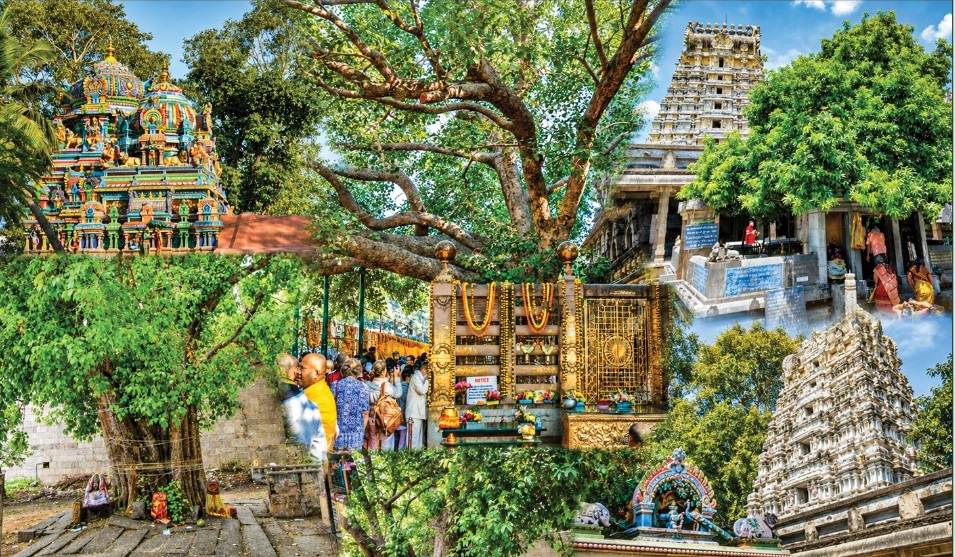
It is easy to imagine that worshippers would choose a spot near a tree, if not under one, for the sake of protection from the harsh sun of a tropical country such as India. Even if the ‘murti’ or Sivalinga were under the open sky, a tree would be much preferred for organising their activities and for resting. Thus every deity would come to be closely associated with the particular tree and this may well be the origin of a designated temple tree which would remain even after the temple was constructed. There are anecdotes associated with many sthalavrikshas in the history of the temples and in some places the fossilised tree of ancient times is still to be found. In some instances, the sthalavriksha is a herb or a creeper.
The temple tree is regarded as representing the deity, in a more accessible form that common people can reach and touch. People with a prayer for a specific desire such as marriage, progeny or good health, would tie flowers, bangles and similar offerings to the tree. Even tiny wooden cradles are tied to the branches of the tree by the childless couples who pray for progeny. Some people undertake ritual disciplines such as a vrata or chanting of a particular devotional stotra for a stipulated period, and visit the temple at intervals such as Paurnami or every Monday, or Friday, and apply tilak of sandal paste and kumkum to the tree. The temple tree, so sanctified, is an integral part of the temple complex as also a water body such as a river or lake or tank.
These trees have medicinal and economic significance and indicate the ecological importance of man co-existing with nature that must be preserved. Bilva, Bauhinia, Marudu, Mango, Banyan, Peepal, Neem, Vanni are frequently found associated with specific temples. The Kadamba vana at Madurai, Tillai at Chidambaram whence it gets its name of Tillai-vanam, the Asokam at Karur, the Jambu at Tiruvanaikka, the coastal Punnai at Mylapore, the Mango tree of the Ekambaresvara at Kancipuram, the Vilva and Punnai at Srirangam, the Arasu at Kanchipuram Varadarajaswami temple are famous examples, to name only a few.
Temples were a hub of social, cultural, religious and economic activity that touched artisans of all kinds. People from neighbouring towns and villages congregated to celebrate festivals during which there were fairs wherein craftsmen sold their wares and musicians and dancers could present performances. The activities of the temple served not only the spiritual and devotional needs of the people but also in character-building. The devotional music often helps people realize the vastness and eternal nature of the world around, although our own lives are short. Devotion is thus considered a path to widening one’s horizons and temples help the younger generation to understand the traditions, culture, art and architecture of our country.

The description of temples in the classical hymns frequently includes orchards and groves resounding with the call of cuckoos and peacocks. Most temples were endowed with lands for rice fields, plantain and coconut groves for their upkeep as well as gardens to grow flowers for worship. In the verdant beauty of the serene temples, one can feel man’s connection with divinity more clearly. This is nearly lost in the present times and would be worth restoring. In modern-day temple complexes we see extensive urbanisation and there is hardly any grove left. The new office rooms and other constructions show scant regard to the architectural harmony of the place. There is sometimes a small garden associated with the temple buildings which is only symbolic of the once dense forests surrounding the region.
Team Siddhanta Knowledge Foundation